AI should hear
where you are
before it answers.
InSync Context shows how the same prompt becomes a short spoken answer in the car, a structured task list at work, or a calm handoff at home.
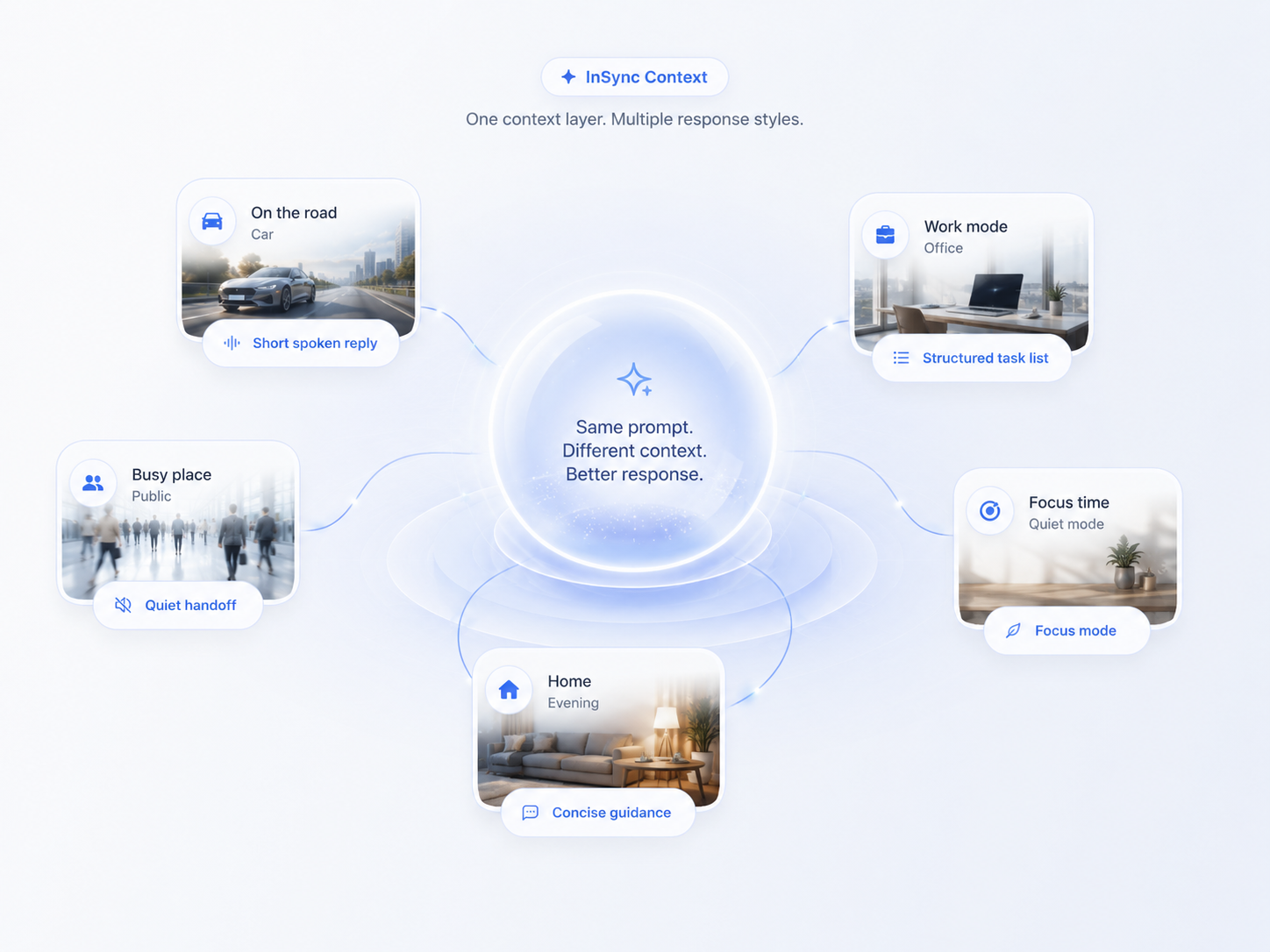
Same prompt. Different response.
Prompt: “Help me plan the rest of my day.” Choose a context below to see how the response changes.
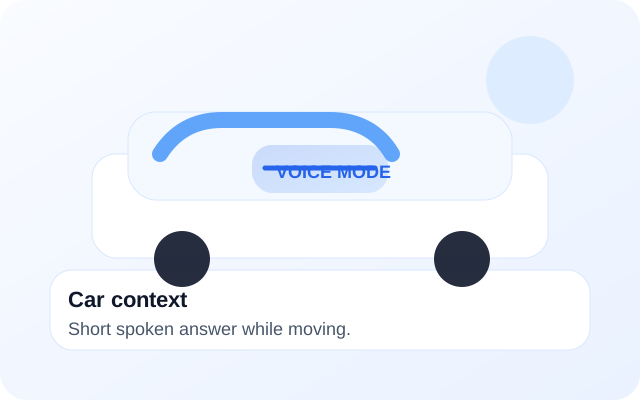
Short spoken answer
You are probably moving, so the answer should be brief, spoken and easy to remember.
🔒 Future audio mode: microphone input stays on device by default. This page simulates the response logic for B2B conversations.
InSync adapted reply
What can you do with this?
Integrate InSync as a context layer into your existing AI product. One API call. Your users get answers that fit their moment.
Better response formats for real users: shorter in motion, structured at work, deeper in focus, calmer at handoff.
 AI assistant layer
Transform one generic assistant into a context-adaptive interface that knows when to speak, summarize or expand.
AI assistant layer
Transform one generic assistant into a context-adaptive interface that knows when to speak, summarize or expand.
 Work & productivity
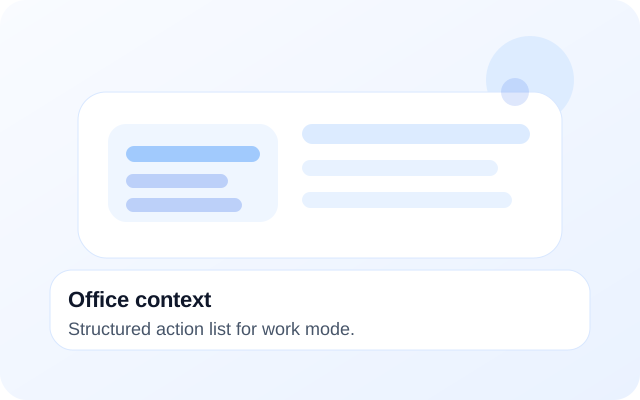
Help teams get shorter answers in motion, structured action lists at work, and cleaner task handoffs at the end of the day.
Work & productivity
Help teams get shorter answers in motion, structured action lists at work, and cleaner task handoffs at the end of the day.
 Wearables & voice
Make voice-first interfaces more useful by adapting response style to environmental sound instead of showing one static answer.
Wearables & voice
Make voice-first interfaces more useful by adapting response style to environmental sound instead of showing one static answer.
Your environment changes how AI should respond.
The prompt determines what the AI should help with. The real-world context determines the shape, tone and amount of detail in the answer.

AI should not force you to adapt to the screen.
Most AI tools still assume the user can read a long answer. InSync flips that: the AI adapts to your reality instead.
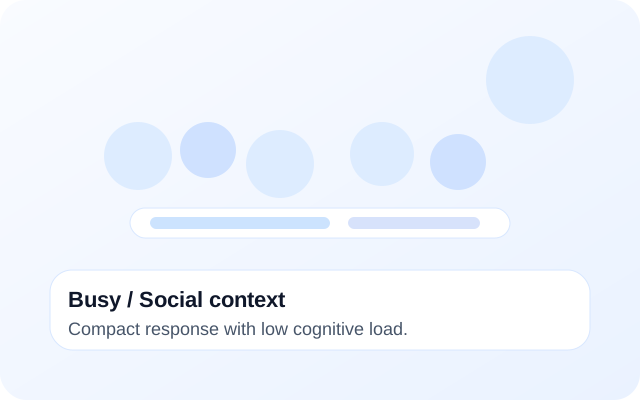
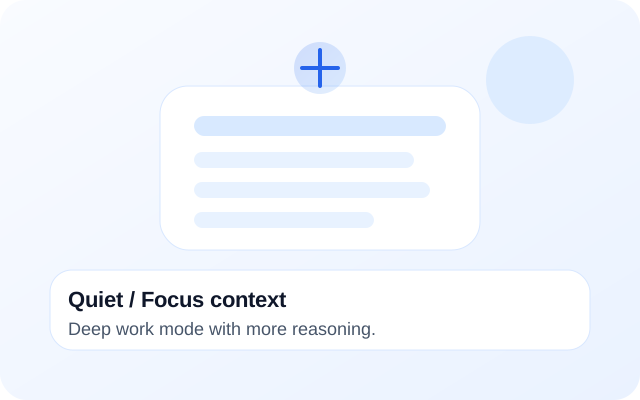
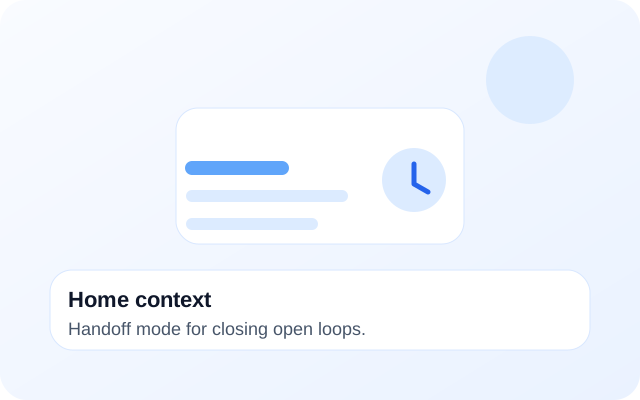
Context changes the form: spoken, structured, compact, deep, reflective or personal.
Codex builds the interactive app.
This page is the public concept page. The next version can embed or link to the React/Vite demo with simulation mode, microphone permission, waveform and local audio classification — and later expose the same logic as a context API for existing AI products.